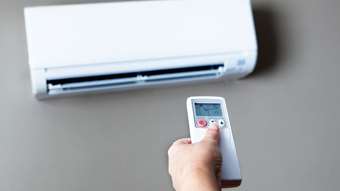
Lessons from Vermonters with ductless heat pumps
More Vermonters than ever are using ductless heat pumps to heat and cool their homes. We talked with two of them about what life is like with a heat pump, how much money they’ve saved, and what they’ve learned along the way.
Middlebury, Vermont
Cindi Duff meticulously tracks how much she spends on electricity and propane. She can rattle off how many kilowatt-hours she used last February, or how much she’s used so far today. “My friends don’t think it’s good dinner-table conversation, but I think it’s fascinating,” she says.
Cindi’s calculations tell a compelling story: Two winters ago, she spent $4,000 on propane and electricity to heat her home. Last winter, after installing a ductless heat pump, she spent $2,300.

How did she cut her heating costs in half? It started with free whole-home weatherization through Vermont’s Weatherization Assistance Program. Cindi’s home isn’t particularly old, but it wasn’t very well air-sealed or insulated. Now she estimates that her living space is 85% warmer thanks to the new insulation and air sealing.
Once her home was weatherized, Cindi had a ductless heat pump installed. She received the heat pump through Efficiency Vermont's free home heating electrification program, offered in partnership with Green Mountain Power, for income-eligible Vermonters. She had originally planned to continue using her propane stove and to use the heat pump as backup instead of electric baseboards. But once she saw how well the heat pump worked in winter, she began using it as her primary heat source and her propane stove became the backup for extra-cold days. “It’s perfect,” she says.
Cindi checks her electric utility account daily, and she tracks her electricity and propane use in a spreadsheet going back many years. Cindi observed that her winter electricity bills increased due to the heat pump, while her propane bill virtually vanished. The result: $1,700 in winter savings. Cindi says with the cost of living in Vermont, that’s valuable money she can spend on other necessities like groceries, gas, and vet bills for her two aging dogs.

But it’s not just about financial savings. Cindi says her home is more comfortable now. After reading a lot about how to use a ductless heat pump, Cindi chose her temperature setting—68 degrees in winter and 78 degrees in summer—and just let it run. “The learning curve is learning not to play around with it,” she says.
For her, the trickiest thing has been cleaning the air filter each month. The ductless heat pump is installed high on the wall in her living room, which has a cathedral ceiling. Cindi uses a telescoping ladder to access the air filter.
Cindi hopes other Vermonters will see the financial benefits and the increased comfort that come from installing a ductless heat pump. “As long as they use it properly, they will never be happier,” she says.
Brattleboro, Vermont
Jerry Showman knows exactly how to turn on his 30-year-old oil furnace: “I go down to the basement and I smack it,” he says. No one can figure out why, but it works.
When he got tired of his unreliable furnace, he started researching heat pumps. He wanted a whole-home heating system, so he knew he’d need multiple ductless heat pumps. He got a wide range of quotes and chose the most affordable option. The heat pumps cost more up front than a new oil furnace, but they cost less to run over time, and they allowed Jerry to add air conditioning to his home.

“It was the best decision I ever made in my home,” he says.
Five heat pumps were installed on the cusp of winter. Even though Jerry works at Efficiency Vermont and knows quite a bit about heat pumps, there was still a learning curve. Jerry fiddled with the temperature settings and learned to go more by feel than by number. Once he had his temperature dialed in, he installed integrated controls, which automatically switch between the heat pumps and the oil furnace. (In this instance, Jerry did the work himself. Most homeowners use a contractor when they install integrated controls to optimize their systems.) The switchover rarely happens because he has a woodstove to help take the edge off on the extra-cold days. He’s been impressed with how the heat pumps handle the cold: “My house stays warm whether it’s 20 degrees or 0 degrees,” he says.
“It was the best decision I ever made in my home.”
Related Posts & Pages

How to maximize your ductless heat pump
Heat pumps can help you save energy and money. When paired with an integrated control to maximize your heat pump’s efficiency, your savings and comfort can improve.

Heat Pump Systems
A heat pump can lower your heating costs considerably and double as a cooling system in the summer.
Jerry says his electric bill went up about $200 a month during the winter, but he only bought oil once compared to three times the previous winter. He estimates saving $1,000 a year on oil and $600 a year on wood. With the added electricity cost, his net savings on heating is about $800 a year.

If he could do it over again, Jerry says he might locate the heat pumps slightly differently. “Don’t mount one right over your bed,” he says. “You’ll have to see the little green light all night.”
One surprising benefit of switching to heat pumps is that his indoor air quality has improved, presumably because the wood stove isn’t running as often. He’s also using less electricity to cool his home in the summer, because the heat pumps are more efficient than his window air conditioners.
Now that he’s seen how much money and energy he can save, Jerry says he has the “return on investment” bug. He recently reinsulated his attic and sealed up some windows to help keep the conditioned air inside.
Every once in a while, he goes down to his basement and smacks his furnace for old times’ sake.
 Electricians
  Heat Pumps